


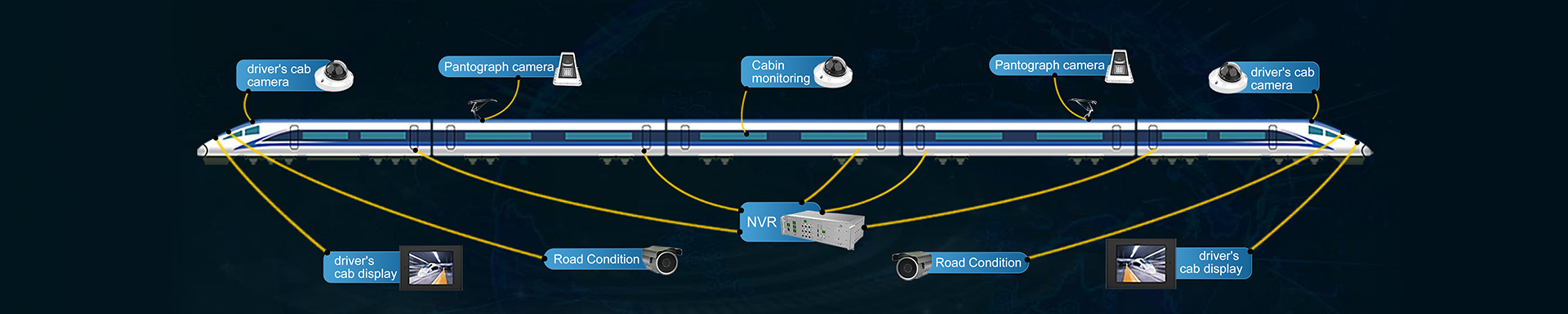
More Cameras Don’t Mean Better Visibility for Locomotives. One 360° View Does.
2026-06-16 09:52A locomotive can have six cameras.
Or eight.
Or even more.
But when the driver is operating in a depot, moving through a yard, approaching a platform, or handling complex shunting work, the real question is not:
“How many cameras are installed?”
The real question is:
Can the driver understand the whole surrounding environment in one glance?
In many locomotive CCTV projects, the answer is still no.
More cameras often mean more video channels. But more video channels can also mean more screen switching, more blind-zone guessing, and more pressure on the driver.
For system integrators, engineering firms, train contractors, and communication contractors, this creates a hidden project risk.
The end user may say:
“The cameras are installed, but the driver still cannot see clearly.”
That is why a locomotive 360° panoramic monitoring system is not just another camera solution.
It is a better way to deliver visibility.
Instead of forcing the driver to watch multiple separated images, one 360° view combines the surrounding camera feeds into a clear, continuous, and easy-to-understand visual interface.
The goal is simple:
Fewer blind spots.
Faster driver judgment.
Clearer video evidence.
Easier project acceptance.
Lower integration risk.
That is why more cameras do not always mean better visibility for locomotives.
One well-designed 360° view does.
Why More Cameras Still Fail to Solve Locomotive Blind Spots?
In traditional onboard CCTV design, the usual answer to a blind spot is simple:
Add another camera.
Side blind zone? Add a side camera.
Fuel tank area? Add another camera.
Rear section? Add a rear camera.
Platform side? Add one more.
This approach may look complete on a technical drawing, but it does not always work well in real operation.
Because the driver does not see “coverage points.”
The driver sees screens.
If the system shows six or eight separated video windows, the driver still needs to compare different views, judge direction, estimate distance, and understand the risk under time pressure.
That is not real visibility.
That is extra workload.
For locomotives, this problem is especially important. A locomotive has a long body, large side blind zones, complex trackside environments, and multiple risk areas, such as the coupling zone, fuel tank area, depot track, side body, platform edge, and maintenance area.
A camera may record the risk.
But if the driver cannot understand it quickly, the system has not fully solved the problem.
For railway operators, this can become a safety concern.
For system integrators, it can become an after-sales issue.
For engineering companies, it can become an acceptance delay.
This is why the conversation should move away from “how many cameras” and toward “how clearly the driver can understand the locomotive environment.”
What Does One 360° View Actually Do?
A locomotive 360° panoramic monitoring system does not mean using only one physical camera.
It means using multiple cameras around the locomotive body and combining their video into one integrated panoramic view.
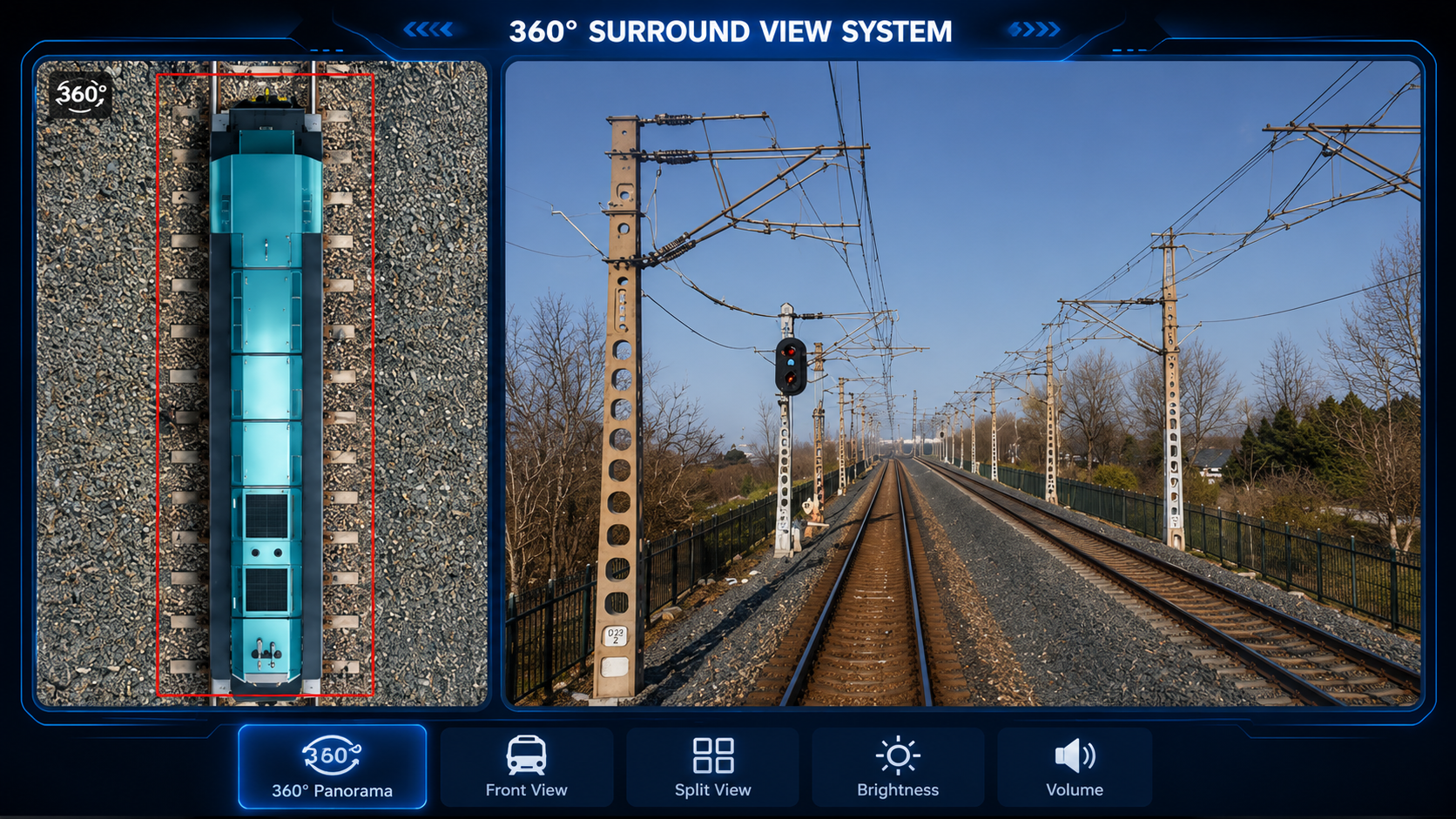
The system usually includes:
panoramic cameras installed around the locomotive;
ultra-HD front road-view cameras;
onboard Ethernet transmission;
intelligent processing host;
image stitching and video fusion;
onboard display screen;
video recording and storage;
sound and light alarm;
optional AI analysis;
optional 5G train-to-ground remote viewing platform.
The driver can see the locomotive’s surrounding environment through one intuitive interface.
This changes the driver experience completely.
Instead of asking:
“Which camera channel should I switch to?”
The driver can immediately understand:
Where is the obstacle?
Which side is the risk on?
How close is it to the locomotive?
Is it safe to continue moving?
Does the system need to trigger an alarm?
That is the core value.
The system does not simply provide more footage.
It provides spatial understanding.
For system integrators and engineering firms, this is also a stronger sales angle.
A normal camera proposal says:
“We provide six cameras and one recorder.”
A better project proposal says:
“We help the driver see the locomotive’s surrounding environment in one 360° view, reducing blind spots and improving operational safety.”
The second message is more valuable.
It speaks directly to the concerns of railway operators, project managers, safety departments, and technical evaluators.
Why System Integrators Should Care About 360° Visibility?
System integrators are often judged by the final user experience, not only by the hardware they supply.
If the camera system works technically but the driver still complains that the view is confusing, the integrator carries the pressure.
If the video is recorded but cannot clearly show what happened during an incident, the integrator may face repeated questions.
If the blind-zone coverage cannot be clearly demonstrated during acceptance, the project may be delayed.
This is why a railway onboard CCTV system should not be positioned as a list of devices.
It should be positioned as a safety visibility solution.
A strong locomotive 360° proposal helps system integrators answer the customer’s real concerns:
Can the driver see the side blind zones?
Can the system support depot and shunting operations?
Can the video help with incident review?
Can the solution be customized for different locomotive models?
Can it integrate with the onboard display, NVR, AI module, and remote monitoring platform?
Can it support long-term operation in railway environments?
When your proposal answers these questions, you are no longer competing only on camera price.
You are competing on project value.
That is where system integrators and engineering firms can stand out.
Where Does a Locomotive 360° Panoramic Monitoring System Create the Most Value?
A 360° system is most valuable in operating scenarios where blind spots are close, risk is frequent, and driver reaction time is limited.
Shunting Operations
Shunting work is usually low-speed, but the risk level can be high.
There may be workers, other vehicles, trackside equipment, coupling actions, tools, and narrow operating spaces around the locomotive.
A 360° panoramic view helps the driver better understand the surrounding environment and reduce side and rear blind-zone risks.
Depot and Yard Movement
Depots and yards are full of inspection lines, maintenance roads, platforms, workshop entrances, and crossing routes.
A front camera alone cannot show the full environment.
A panoramic system allows the driver to see the relationship between the locomotive and nearby objects more clearly.
Fuel Tank and Side Body Monitoring
Many diesel locomotive projects require visibility around the fuel tank, side body, equipment cabinet, and lower vehicle area.
A single fixed camera may only show a partial image.
A 360° view provides better context, helping the driver understand where the risk is located relative to the whole locomotive.
Platform and Trackside Risk Zones
When a locomotive moves near platforms, station areas, or trackside equipment, side visibility becomes very important.
One panoramic interface helps the driver judge direction and distance more intuitively.
Remote Monitoring and Incident Review
When connected with a 5G train-to-ground data transfer platform or video surveillance management platform, the system can support remote viewing, centralized management, video playback, and post-incident analysis.
This is valuable for railway operators.
It is also valuable for contractors, because clear video evidence can reduce disputes after delivery.
What Should Engineering Firms Check Before Choosing a Supplier?
For engineering firms and railway contractors, choosing a 360° supplier is not only about price.
It is about whether the system can be installed, integrated, accepted, and maintained successfully.
Before selecting a locomotive 360 surround view system, these points should be checked carefully.
First, the system must be railway-grade.
Locomotive equipment needs to handle vibration, shock, temperature changes, EMC interference, power fluctuation, dust, moisture, and long operating hours. A general commercial vehicle camera system is not enough for railway use.
Second, the supplier must understand full system integration.
A reliable 360° solution is not only cameras. It includes cameras, intelligent host, display, network, storage, power supply, software, alarm output, cables, installation structure, and platform interface.
Third, image stitching and calibration must be customized.
Different locomotive models have different body lengths, mounting positions, blind zones, cable routes, and installation spaces. If the supplier cannot support calibration and customization, the final display effect may not meet project expectations.
Fourth, the display interface must be driver-friendly.
Drivers do not need a complicated system. They need a clear interface, quick view switching, stable images, low latency, and easy understanding.
Fifth, maintenance must be considered from the beginning.
System integrators need technical documents, spare parts, fault diagnosis, video export, software upgrade support, and fast engineering response.
Sixth, customization ability is critical.
Railway projects rarely use one standard configuration for every vehicle. Camera layout, housing, connector, display logic, communication protocol, alarm linkage, and remote platform interface may all need adjustment.
A supplier without customization capability may create hidden project risk.
Why TIENUO’s Locomotive 360° Solution Is Built for Rail Projects?
At TIENUO, we do not treat locomotive visibility as a simple camera problem.
We treat it as a complete railway safety system.
Our locomotive 360° panoramic monitoring system is designed for railway vehicles and project-based integration.
It can combine panoramic cameras, ultra-HD road-view cameras, intelligent analysis host, onboard display, video storage, alarm output, AI analysis, and optional 5G train-to-ground transmission.
For system integrators, this means less integration pressure.
For engineering firms, this means easier project design.
For contractors, this means smoother installation and acceptance.
For railway operators, this means the driver can get a clearer view of the surrounding environment.
TIENUO’s value is not only supplying hardware.
We support railway-focused customization, including camera layout design, installation structure, software interface, system integration, project documentation, and technical communication.
This is especially important for international railway projects, where system integrators and contractors need a supplier who can respond quickly and understand real rail operation requirements.
A cheaper camera may win attention.
But a complete railway-grade 360° visibility solution wins trust.
Conclusion: Stop Selling Cameras. Start Delivering Visibility.
More cameras can create more video.
But more video does not always help the driver make a better decision.
A locomotive driver needs one clear answer:
What is around the locomotive?
Where is the risk?
Can I move safely?
Will the system warn me in time?
Can the video show what happened later?
That is why more cameras do not mean better visibility for locomotives. One 360° view does.
A well-designed locomotive 360° panoramic monitoring system helps reduce blind spots, improve driver awareness, support video evidence, simplify acceptance, and strengthen the competitiveness of system integrators and engineering firms in railway projects.
If you are working on a locomotive CCTV project, depot monitoring project, shunting safety upgrade, or rolling stock video surveillance system, TIENUO can support you with a customized 360° panoramic visibility solution based on your vehicle model, installation environment, project requirements, and integration needs.
Looking for a railway-grade 360° monitoring solution for your next locomotive project?
Send us your vehicle type, camera layout requirement, installation environment, and project schedule. Our engineering team can help you design a tailored solution.