


Railway Monitoring Display Terminals: Clear Video, Faster Alarm Response, Reliable Onboard Operation
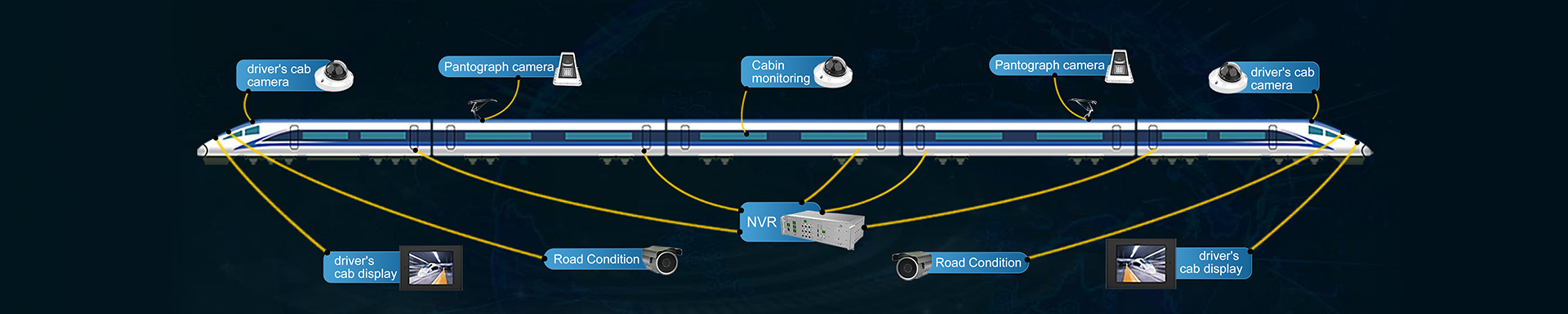
2026-06-02 16:09In railway video surveillance projects, cameras capture the image, NVRs store the data, and AI servers analyze events.
But the display terminal is what helps drivers, maintenance teams, and operators make fast decisions.
It is not just a screen.
It is the key human-machine interface in an onboard railway safety monitoring system.
Why Commercial Displays Are Not Enough
A train environment is far more demanding than an office, a station control room, or a normal industrial site.
Onboard display terminals must handle continuous vibration, shock, temperature changes, voltage fluctuation, electromagnetic interference, dust, humidity, and long operating hours.
When the display terminal is unstable, the issue is not only poor image quality.
It directly affects alarm confirmation, video playback, fault tracing, and response efficiency.
For railway system integrators, railcar manufacturers, and security solution providers, this is a real project delivery risk.
Our Solution
Shandong Tienuo Intelligent provides train-grade audio and video display terminals for onboard railway video surveillance systems.
The series covers 6.5-inch to 24-inch models, supporting driver cab monitoring, carriage surveillance, equipment room monitoring, pantograph monitoring, monitoring cabinets, and large-screen HD display scenarios.
The terminals support high-resolution display, multi-screen video display, HD playback, resistive or capacitive touch options, DC110V power supply, wide-temperature operation, full-metal structure, IP63 protection, anti-vibration design, anti-theft structure, and standard communication interfaces for onboard railway applications.
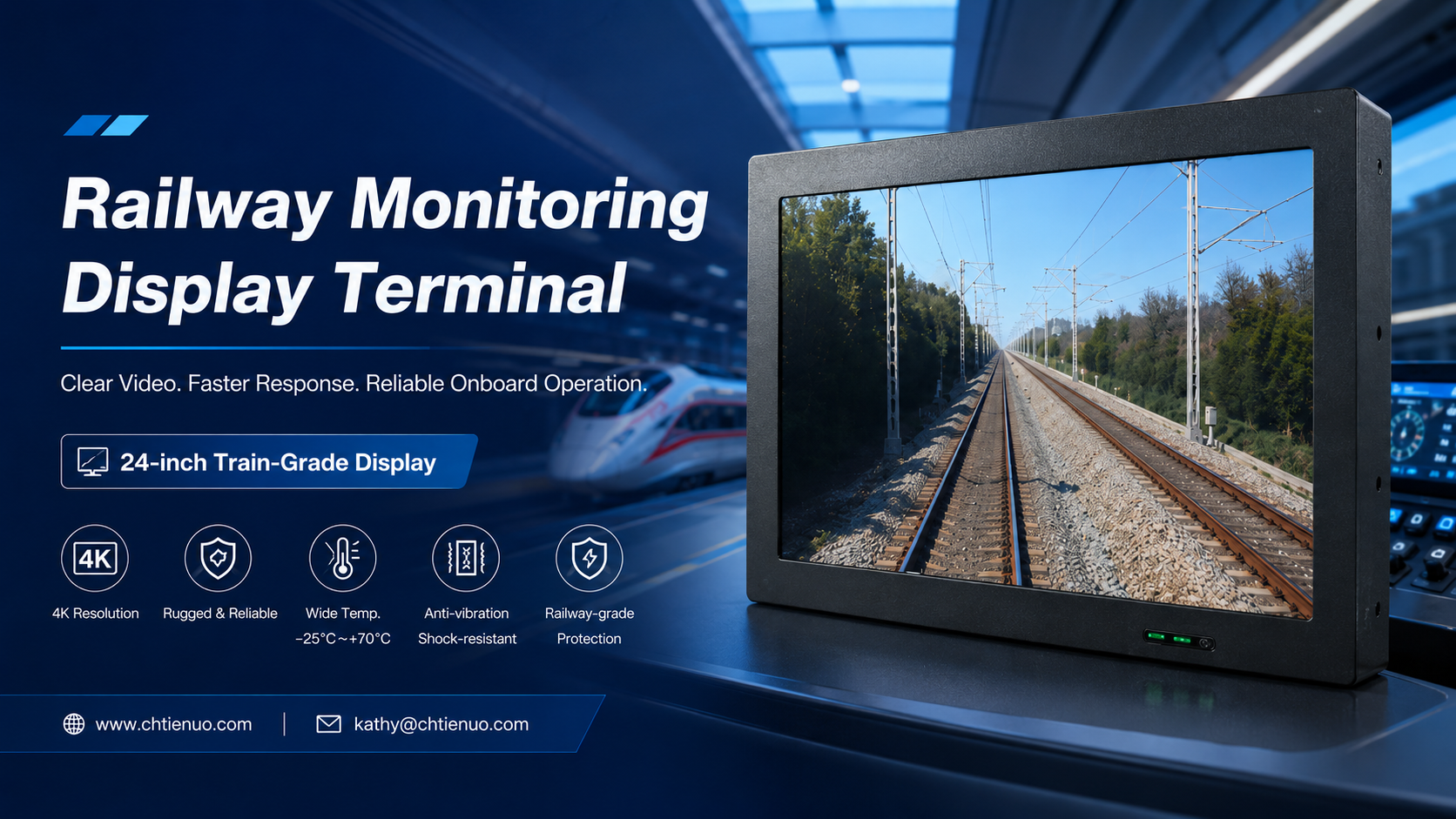
24-Inch Railway Monitoring Display Terminal
For large-screen HD monitoring projects, the 24-inch audio and video display terminal supports:
3840 × 2160 4K resolution
M12 network interface
Dual network redundancy
HDMI interface
Two USB 3.0 interfaces
DC110V power supply
-25°C to +70°C operating temperature
Strong anti-interference capability
Power-off protection
Professional anti-vibration and anti-loosening interface design
MTBF over 100,000 hours
10ms power interruption and power-loss protection
For railway projects, the value is straightforward:
Clearer video, more stable connectivity, lower integration risk, and more reliable long-term operation.
Application Scenarios
The display terminal series can be used in:
Locomotive remote video monitoring systems
Driver cab video surveillance systems
Crew status warning systems
Passenger coach onboard CCTV systems
EMU carriage video monitoring systems
Pantograph video monitoring and intelligent analysis systems
Fire warning and automatic extinguishing systems
Onboard NVR recording, playback, and alarm confirmation systems
It can work with onboard cameras, NVRs, AI analysis servers, 5G transmission platforms, and ground monitoring platforms to build a complete onboard video surveillance loop.
Why Partners Should Care
For system integrators, the display terminal directly affects the end-user experience.
For railcar manufacturers, it improves the stability of the onboard safety system.
For railway security solution providers, it helps turn a video surveillance solution from “video available” into clear viewing, stable operation, and faster response.
The value of railway safety monitoring is not only about capturing video.
It is about presenting critical video and alarm information clearly, reliably, and at the right moment.
That is why train-grade monitoring display terminals matter.